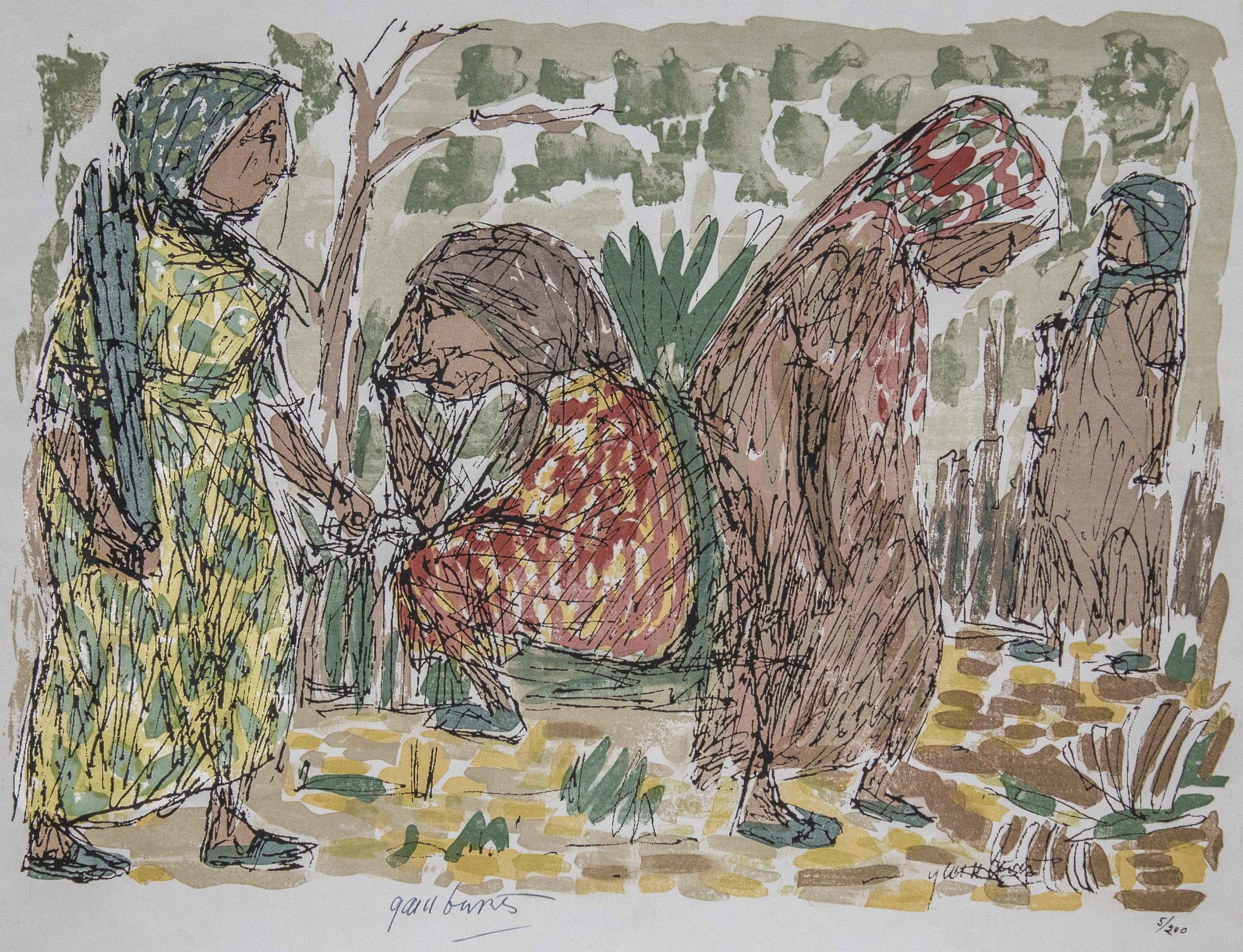
Landscape with figures
Ficha técnica
Gambartes’ work is rooted in the concept of the telluric, the vital force of the earth, which unites memory, ritual and identity.
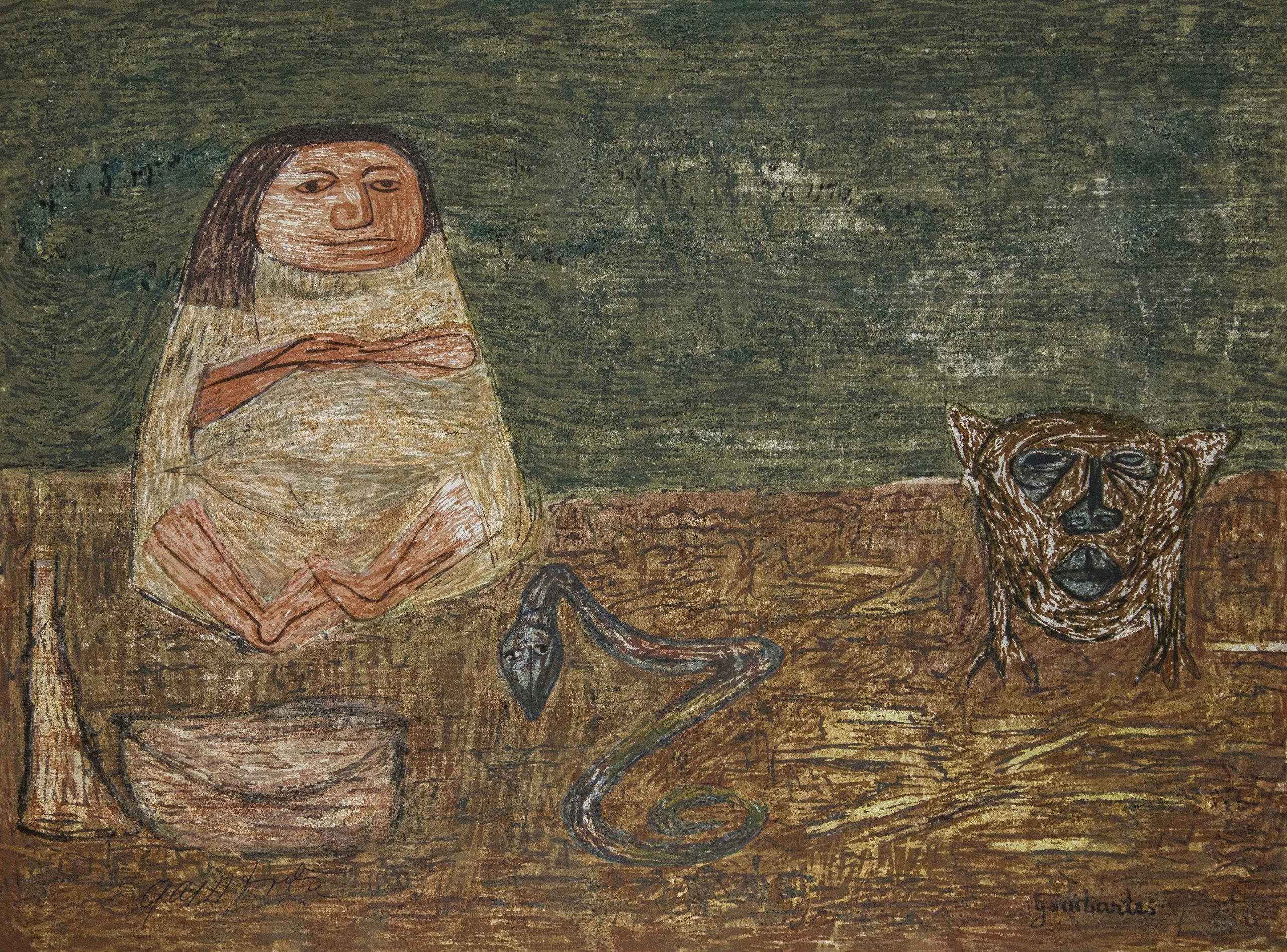
As is typical in his work, Gambartes depicts a female figure here, in this case seated and at rest, located in a flat landscape reduced to its essential elements. Next to her are grinding implements, alongside a snake and a dog with shapes, far removed from naturalism, that allude to a symbolic or mythical dimension. The snake, staring directly at the viewer, introduces a silent tension into the scene, while the dog takes on features that place it on an ambiguous plane between the real and the spiritual. Positioned in front of the dog, the woman appears impassive, with her legs and arms crossed and a half smile on her face, conveying a sense of calm and self-restraint. Her physiognomy clearly points to her having indigenous blood.
Even though it is part of the thematic series Figuras y paisajes, this piece could easily fit within the more symbolic or “magical” side of Gambartes’ work, both for its colour palette and in the inclusion of elements that suggest implicit meanings. This coexistence of styles reflects the artist’s ongoing interest in representing ancestral identity not only in its visible dimension but also in its more intangible aspects.
The scene can be understood as a manifestation of the profound relationship between human beings, the land and the forces that inhabit it. The elements depicted do not appear as isolated entities but as parts of the same interdependent system. The grinding, even when at rest, alludes to practices linked to the transformation of matter and the continuity of ancestral knowledge. The presence of the snake and the dog also introduces a spiritual dimension connected to nature, reinforcing the idea of a living environment that influences and is influenced by human action.
In this context, the female figure takes on a central role as a repository and transmitter of knowledge, linked to care of the land and a balanced ecosystem. Through her, Gambartes evokes the collective memory of Indigenous communities, as well as the transmission of practices and values from generation to generation.
The artist uses the screen-printing technique for this piece, maintaining his interest in material experimentation and construction based on textures. In certain aspects, the visual result is reminiscent of the appearance of the plaster chrome technique, reinforcing the connection between matter, surface and meaning, and once again underscoring the telluric dimension that runs through his work.
References:
Burucúa, José Emilio; Kwiatkowski, Nicolás. “La serpiente y la magia”. In: Ninfas, serpientes y constelaciones. La teoría artística de Aby Warburg [Exhibition catalogue]. Museo Nacional de Bellas Artes, Buenos Aires, 2019, pp. 74-75.
https://issuu.com/museonacionaldebellasartes/docs/catalogo_aby_warburg [Date consulted: 01/03/2024].