
Las yuyeras II series
Ficha técnica
Gambartes’ work is rooted in telluric aspects related to the earth, the life force of the land, which combines memory, ritual and identity.
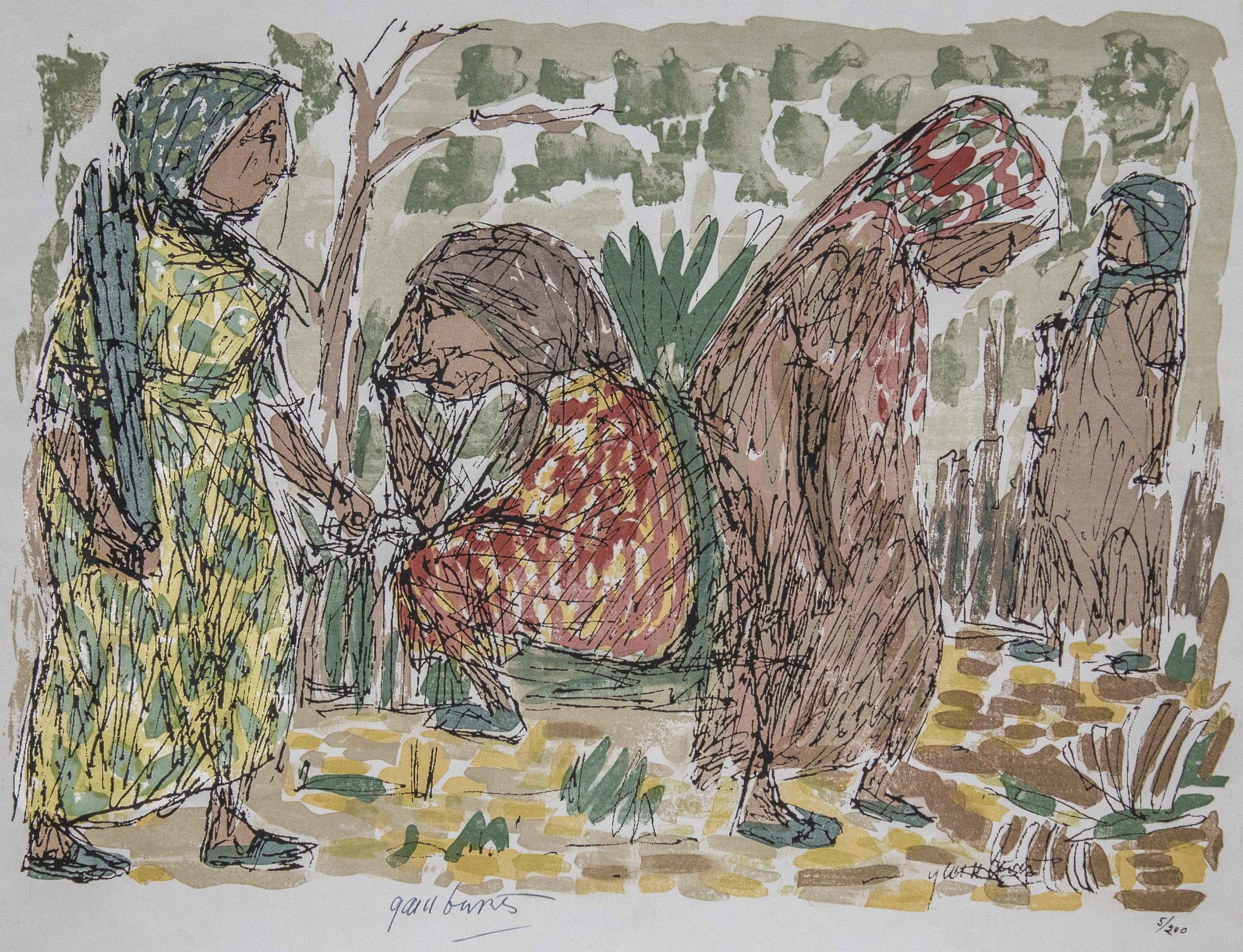
In Serie las yuyeras II, Gambartes depicts a group of female figures linked to gathering herbs. This traditional practice is deeply rooted in folk knowledge and in a direct relationship with the natural environment. The figures, arranged in a simplified manner and with geometry clearly predominant, are part of a landscape that is reduced to its essential elements, where the horizon sets out a clear division between earth and sky. This spatial simplification shifts the focus to the action and towards the relationship between the women and the territory they inhabit.
These yuyeras, or “female herbalists”, are not merely depicted as workers, but as bearers of ancestral knowledge linked to the use of plants, traditional medicine and caring for life. Their measured and repetitive gestures allude to a practice passed down from generation to generation, in which the everyday takes on a symbolic dimension. The lack of individualisation in their faces reinforces their collective nature, underscoring the idea of community over individual identity.
From a telluric perspective, this work reveals the deep connection between the human figures and the earth as a source of life, knowledge and sustenance. The gathering of herbs is not presented as an extractive activity, but as part of a balance in which human beings interact with their environment respectfully and interdependently. Gambartes expresses a vision in which nature is an active agent that shapes community culture and identity.
The female figure here takes on a central role as a mediator between the natural and social worlds, linked to caregiving, passing down knowledge and preserving the ecosystem’s balance. Through these depictions, the artist highlights the importance of women in the sustainability of community life and in the continuity of practices that combine the material and the spiritual.
In formal terms, this work adheres to the principles that permeate Gambartes’ production in dialogue with Constructive Universalism: the geometric organisation of space, the synthesis of forms, the absence of illusionistic depth and attention to proportions between elements. These resources not only provide structure to the composition but also contribute to reinforcing the symbolic dimension of the scene, in which memory, identity and territory are presented as inseparable realities.
References:
Gambartes [Exhibition Catalogue]. Centro Cultural Recoleta, Buenos Aires, 2003. Available online: https://www.forosur.com.ar/site/assets/files/1099/gambartes.pdf [Date consulted: 01/03/2024].
Flores Ballesteros, Elsa. “Introducción a la obra de Leónidas Gambartes”. In: Wechsler, Diana; Sevlever, Rubén; Flores Ballesteros, Elsa (et al.). Gambartes. Ediciones Castagnino+macro, Rosario, 2013. ISBN: 978-987-26457-1-7. Available at: https://www.castagninomacro.org/archivos/editorial/23._gambartes.pdf [Date consulted: 29/02/2024].