
La Morteada
La Morteada, 1952
Ficha técnica
Gambartes’ work is rooted in the concept of the telluric, the vital force of the earth, which unites memory, ritual and identity.
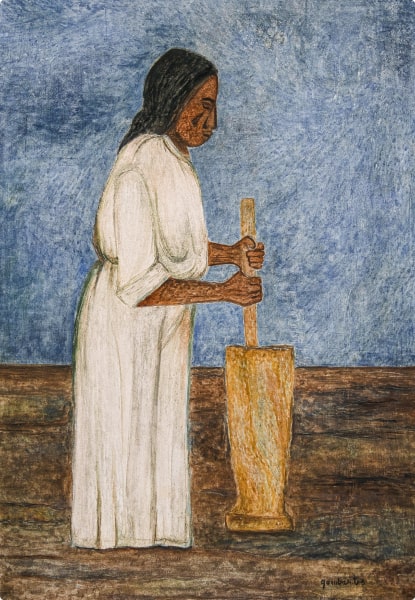
In La Morteada, Gambartes depicts a female figure going about her everyday work, occupying almost the entire composition. In front of her is a large mortar; she is holding the pestle in her hands. This action alludes to ancestral practices linked to the transformation of matter. The woman is in profile; her face and the grinding instruments are completely flat, in contrast to the representation of her torso, hands and even her dress, in which the volume of her body is softly portrayed. In spite of this, the hieratic nature of the piece and a composition based on flat and geometric shapes prevail in the figure.
The space in which the scene is set is reduced to its essentials: earth and sky are separated by a straight horizon line, free of any extraneous elements. This schematism reinforces the symbolic dimension of the image.
This work corresponds to one of the fundamental themes in Gambartes’ production: depicting women engaged in everyday activities (such as grinding corn, gathering herbs and washing clothes) as bearers of knowledge and community practices. From a telluric perspective, these figures embody the vital force of the earth and its capacity to shape the culture and identity of those who inhabit it. The act of grinding goes beyond the functional and is imbued with memory and ritual, linked to passing on knowledge and sustaining life.
The artist’s characteristic use of the cromo al yeso technique, translated as “plaster chrome”, reinforces this material connection to the earth, bringing together the support and the meaning. Likewise, the composition is reminiscent of works such as La Pileta (1949), where Gambartes started to develop a language in dialogue with the principles of Constructive Universalism. In both pieces, the geometric organisation of space, formal synthesis, an absence of illusionistic depth and attention to proportions can be noted, revealing influences from Joaquín Torres García’s teachings.
From this perspective, this work not only represents an everyday scene but also expresses a vision in which human, natural and spiritual aspects are deeply interconnected. The female figure thereby takes on a central role as an agent of cultural continuity, stewardship of the land and balance among the different elements that make up the ecosystem.
References:
Gambartes [Exhibition Catalogue]. Centro Cultural Recoleta, Buenos Aires, 2003. Available online: https://www.forosur.com.ar/site/assets/files/1099/gambartes.pdf [Date consulted: 01/03/2024].
Flores Ballesteros, Elsa. “Introducción a la obra de Leónidas Gambartes”. In: Wechsler, Diana; Sevlever, Rubén; Flores Ballesteros, Elsa (et al.). Gambartes. Ediciones Castagnino+macro, Rosario, 2013, p. 126. ISBN: 978-987-26457-1-7. Available at: https://www.castagninomacro.org/archivos/editorial/23._gambartes.pdf [Date consulted: 29/02/2024].
https://gambartes.com/obras/la-pileta/ [Date consulted: 15/10/2024].